
If you’ve ever assigned a student a “job” and watched them stare at you like you spoke a different language, you know classroom jobs aren’t as plug-and-play as Pinterest makes them look. In a special education setting, a job isn’t just a task on a chart. It’s a chance for a student to practice following directions, staying on a routine, and feeling like they contributed to something. That’s very important!
Here’s what classroom jobs in special education actually do for our students, why the list matters less than the system behind it, and 40 job ideas you can pull from right now.
Why Classroom Jobs in Special Education Classrooms Matter
Classroom jobs give students a reason to practice skills we’re already targeting. A few things they build:
- Responsibility – Students learn a task is theirs to finish, not something that gets done for them.
- Teamwork – Jobs put students in a position to rely on each other, not just on you or your para.
- Self-esteem – Finishing a job, even a small one, gives a student proof they can do something well.
- Organization and time management – Jobs are a low-stakes way to practice sequencing and follow-through.
- Community – Everyone has a role. That matters more in a room where students are used to being helped rather than needed.
- Life skills – These are the same skills we’re trying to build toward independence outside the classroom.
None of that happens automatically just because you assigned classroom jobs in special education. It happens because you taught it, modeled it, and gave the student time to practice before you expected mastery.
40 Classroom Job Ideas
Pull whatever fits your room. Not every job works for every classroom, and that’s fine. Adjust the language, add a visual, or pair a job with a peer buddy as needed.
- Line Leader: Leads the line when the class transitions between activities or locations.
- Door Holder: Holds the door open for classmates when entering or exiting the classroom.
- Attendance Helper: Takes attendance and reports absences to the teacher.
- Calendar Helper: Updates the classroom calendar with the date, day of the week, and any special events.
- Weather Reporter: Checks and reports the daily weather to the class.
- Board Cleaner: Erases the whiteboard or chalkboard at the end of the day.
- Messenger: Delivers messages or materials to other classrooms or the office.
- Paper Passer: Distributes papers and assignments to classmates.
- Pencil Sharpener: Ensures all pencils are sharpened and ready for use.
- Supply Monitor: Checks and replenishes classroom supplies, such as markers, glue, and scissors.
- Library Helper: Organizes and maintains the classroom library.
- Technology Assistant: Helps set up and manage classroom technology, like computers or tablets.
- Trash Monitor: Ensures the trash is taken out and the classroom remains clean.
- Recycling Captain: Manages the recycling bin and ensures items are properly recycled.
- Desk Inspector: Checks that desks are neat and organized.
- Plant Caretaker: Waters and takes care of classroom plants.
- Pet Monitor: Feeds and cares for any classroom pets.
- Line Caboose: Stays at the end of the line to ensure all students are accounted for.
- Classroom Greeter: Welcomes visitors and new students to the classroom.
- Snack Helper: Distributes snacks during snack time.
- Hand Sanitizer Distributor: Ensures students use hand sanitizer before meals and after activities.
- Homework Collector: Collects and organizes homework assignments.
- Time Keeper: Keeps track of time during activities and reminds the teacher of schedule changes.
- Chair Stacker: Stacks chairs at the end of the day or when needed.
- Table Wiper: Cleans tables after activities or meals.
- Lost and Found Monitor: Manages the lost and found area.
- Cubby Organizer: Ensures cubbies or lockers are neat and tidy.
- Lights Monitor: Turns lights on and off as needed.
- Quiet Captain: Helps maintain quiet during independent work time.
- Buddy System Manager: Pairs students for buddy activities and checks in on pairs.
- Song Leader: Leads the class in songs or chants.
- Cheer Captain: Encourages and motivates classmates during activities.
- Schedule Helper: Assists in maintaining the daily schedule and keeping the class on track.
- Homework Checker: Checks that all students have completed their homework.
- Emergency Drill Leader: Assists in organizing students during emergency drills.
- Substitute Helper: Assists substitute teachers by explaining routines and rules.
- Birthday Coordinator: Helps organize and celebrate classmates’ birthdays.
- Game Manager: Organizes and manages classroom games and activities.
- Book Buddy: Pairs up with younger students for reading time.
- Reflection Leader: Leads end-of-day or week reflection activities.
How to Actually Manage Classroom Jobs (So They Don’t Fall Apart by October)
The list is the easy part. Managing it is where most job charts quietly die.
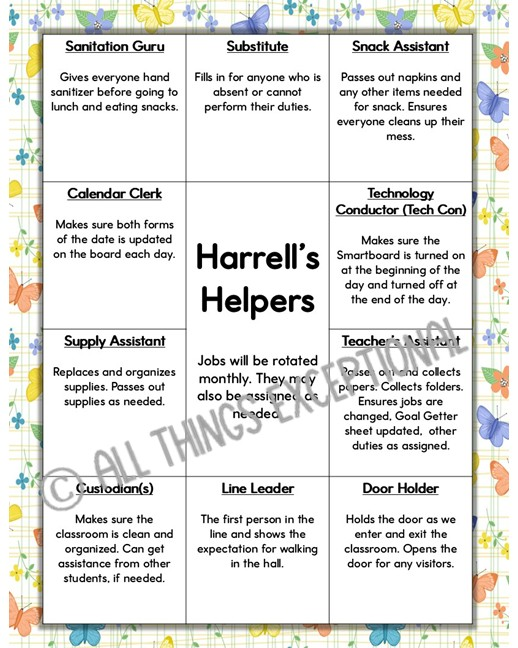
Rotate on a schedule you’ll actually keep. Weekly, biweekly, monthly, whatever fits your classroom rhythm. Pick one and stick with it, because inconsistent rotation confuses students faster than no rotation at all.
Build a visual job chart. Students need to see who has what job without asking you every five minutes. Add a short description (in my examples above) next to each job. That description also saves your para and any substitute from guessing what “Desk Inspector” is supposed to mean.
Train before you rotate. Spend the first two weeks of school introducing the chart, modeling each job, and letting students try more than one. Some teachers rotate jobs daily during this window just to see who likes what. This is also where you figure out who needs more visual support, more steps broken down, or more practice time before a job goes on their plate for real.
Give feedback and revisit it. A quick check-in on how the job went, what was hard, and what helped goes further than any sticker chart.
Adjust for the student in front of you. A job isn’t one-size-fits-all in a special ed classroom. Simplify steps, add a picture schedule, pair with a peer, or shorten the job duration if that’s what a student needs to succeed at it.
Classroom jobs in special education work when they’re taught like any other skill: with modeling, practice, and room to adjust. Do that, and you’ve got more than a chart on the wall. You’ve got 40 chances a week for a student to feel capable.
Looking for more classroom management ideas in special education? Check out these blogs.
The Common Board Configuration (CBC): A Classroom’s Heartbeat





No Comments